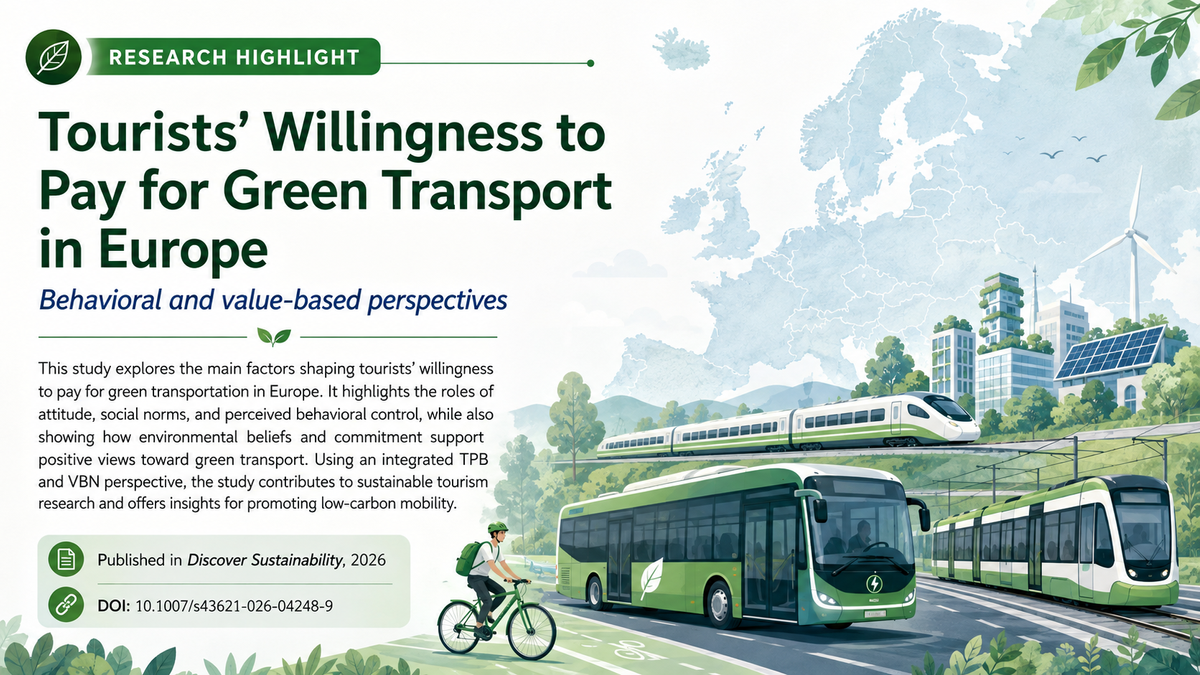
Determinants of tourists’ willingness to pay for green transport in Europe from behavioral and value-based perspectives

The research investigates the factors that influence tourists’ willingness to pay for environmentally friendly transportation options in Europe. Drawing on the Theory of Planned Behavior (TPB) and Value–Belief–Norm (VBN) theory, the study examines how behavioral, environmental, and value-based factors shape tourists’ preferences for green transportation. Data were collected from 259 European tourists and analyzed using Partial Least Squares Structural Equation Modeling (PLS-SEM).
The findings show that tourists’ attitudes, subjective norms, and perceived behavioral control are important factors associated with their willingness to pay for green transportation. The study further finds that environmental beliefs and environmental commitment positively shape tourists’ attitudes toward green transport. Perceived moral obligation is associated with subjective norms, while perceived consumer effectiveness strengthens perceived behavioral control. Interestingly, environmental concern alone was not found to have a significant influence on tourists’ attitudes toward green transportation.
The study contributes to the growing literature on sustainable tourism by integrating behavioral and value-based perspectives to better understand tourists’ willingness to financially support low-carbon and environmentally responsible transportation. The findings may also provide useful insights for policymakers, tourism authorities, destination managers, and transport providers seeking to encourage the adoption of greener mobility options within the tourism sector.
Research Images